
Guide
Ostend's monuments, statues and remarkable houses: a self-guided tour
Royal colonnades, belle époque villas, a modernist post office and the city’s best-loved statues: a self-guided tour of Ostend’s monuments and the stories behind them.
By Redactie Ostend City Guide · Updated 14 October 2026
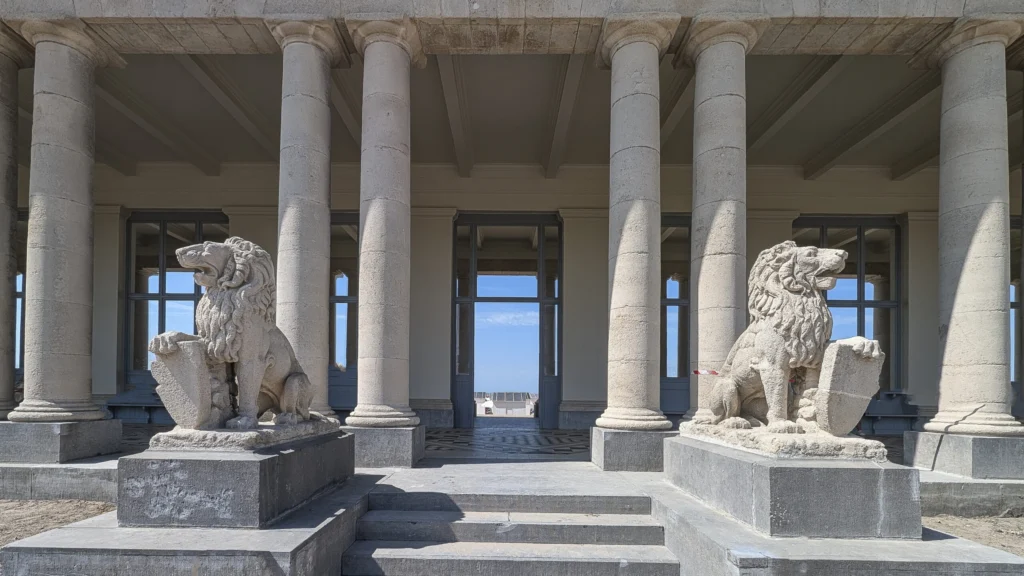 Photo: Paul Hermans, CC BY-SA 4.0
Most visitors come to Ostend (Oostende) for the beach and the fish, and leave without noticing that they have walked past one of the most interesting townscapes on the North Sea. King Leopold II wanted to turn his favourite seaside town into a royal resort, and he left it colonnades, galleries and a racecourse. The Second World War took a lot away, and the 1950s rebuilt it in confident modernist style. In between you find a Gothic tower from 1478, a stable in the shape of a Norwegian stave church and a reclining bronze nude the locals call Fat Mathilde.
This guide picks out the monuments, statues and houses that are worth a detour, grouped by area so you can link them into a walk. Almost everything here can be seen from the street for free. We checked the facts against the Flemish heritage inventory and recent news reports, but restorations and closures change things quickly, so check before you plan a visit inside.
At a glance
| Landmark | Area | What it is | Go inside? |
|---|---|---|---|
| Royal Galleries | Seafront | Leopold II’s 366-metre colonnade (1902–06) | Yes, open-air, free |
| Leopold II monument | Seafront | Equestrian statue and arches (1931) | Outdoor |
| Venetian Galleries | Seafront | Neoclassical galleries with a copper dome (1900–01) | Yes, Mu.ZEE exhibitions (paid) |
| Villa Maritza | Seafront | One of the last 19th-century seafront villas (c. 1885) | No |
| Kursaal and Dikke Mathille | Seafront | 1953 casino and the city’s favourite statue | Concert hall closed until 2027 |
| Church of St Peter and St Paul | Centre | Neo-Gothic church and the Peperbusse tower | Yes, free |
| Leopold I statue | Centre | Equestrian statue known as ‘t Peird (1901) | Outdoor |
| James Ensor House | Centre | The painter’s home and studio | Yes, paid |
| De Grote Post | Centre | Modernist post office, now a culture centre (1953) | Yes, during opening hours |
| Ostend station | Station quarter | Belle époque station from 1913 | Yes |
| Lange Nelle | Oosteroever | 57.5-metre lighthouse (1949) | No |
| Fort Napoleon | Oosteroever | Five-sided fort from 1810–14 | Yes, paid |
| Royal Stables | Near the racecourse | Norwegian-style wooden stables (1904) | Sports centre |
| Duinenkerk and Ensor’s grave | Mariakerke | Gothic dune church from the 14th century | During Mass only |
Along the seafront: Leopold II’s royal resort
The Royal Galleries and Thermae Palace
The Royal Galleries (Koninklijke Gaanderijen) are the grandest thing on the Belgian coast: 366 metres of paired Doric columns in pale Euville stone, built between 1902 and 1906 so the royal family could walk from their chalet to the Wellington racecourse without getting wet. The architect was Charles Girault, who also designed the Petit Palais in Paris, and the roof terrace was one of the first reinforced-concrete structures in Belgium. After about thirty years of decay, the first restored section reopened in July 2026 and is open to everyone at all times, with sheltered benches facing the sea. Look for the stone lions guarding the pavilion steps.
Built against the galleries is the Thermae Palace, opened in 1933 by King Albert I and Queen Elisabeth as a thermal bath for Ostend’s mineral spring, discovered in 1856. It has a sober neoclassical exterior and an Art Deco interior full of tiles and mosaics, and became a hotel after the Second World War. The hotel is still open. The city approved a major restoration plan in June 2026, with work expected to start in early 2027.
The Leopold II monument and the Drie Gapers
Where the two colonnades meet, three arches known as the Drie Gapers (the “Three Gapers”) frame a bronze equestrian statue of Leopold II, unveiled in 1931. The statue is by Alfred Courtens; his brother Antoine designed the arches and pedestal. It is also the most contested monument in town. One sculpture group at the base shows grateful Congolese, a version of history that ignores the brutal rubber regime in Leopold’s Congo Free State. In 2004 activists sawed the hand off one of the kneeling figures, a reference to the hands cut off under that regime, and it has never been restored. Since 2016 a city panel at the foot of the statue gives the historical context. It is worth stopping here to read it.
The Venetian Galleries and King Baudouin
A few minutes east, the Venetian Galleries (Venetiaanse Gaanderijen) were built in 1900–01 to a design by Henri Maquet, with a copper-domed belvedere on top. Their garden is now the small public Koningspark, and a bronze of King Baudouin by Josiane Vanhoutte stands in front. Until 2028 they are the temporary home of Mu.ZEE, Ostend’s art museum, so a museum ticket gets you inside. Local lore adds a tunnel that once led under the Parijsstraat to the villas where Leopold II’s mistress, Baroness Vaughan, lived.
Villa Maritza, Villa Francine and Marvin Gaye’s flat
The seafront was once lined with villas; today a handful survive between the apartment blocks. Villa Maritza (Albert I-Promenade 76), built around 1885, is the best known, an eclectic mix of neo-Flemish Renaissance and neo-Baroque that was saved from demolition in the 1980s and protected in 1996. A little further west, Villa Francine (Albert I-Promenade 88, 1894) has tiled panels by Boch Frères in its loggia. Both are private, so enjoy them from the promenade.
Right next door to Villa Maritza, at number 77, is the apartment where Marvin Gaye lived in 1981–82 and wrote “Sexual Healing”. He came to Ostend at the invitation of the concert promoter Freddy Cousaert to get away from his problems in the United States. A plaque in the pavement outside marks the spot.
The Kursaal and Dikke Mathille
The present Kursaal casino, by the Antwerp architect Léon Stynen, opened in 1953 on the site of two earlier casinos; the second was demolished by the Germans for the Atlantic Wall. Inside are murals by Paul Delvaux and works by Oscar Jespers and Edgard Tytgat, and the foyer has a life-size bronze of Marvin Gaye at the piano. The concert hall has been closed for a major refit since late 2024 and is due to reopen in January 2027, so the foyer artworks may not be visible until then.
Across the road, in a pond on the Leopold II-laan, lies Ostend’s best-loved statue: Dikke Mathille (“Fat Mathilde”), a full-figured reclining bronze nude by Georges Grard from 1954, officially titled De Zee (The Sea). Nearby, in the same pond, Femmy Otten’s marble Moeder (Mother), made for the Beaufort art triennial in 2024, has stayed for good. A few steps further, in Leopold Park, stands a bronze bust of James Ensor on an Art Deco pedestal decorated with masks and skulls; it is a 1985 copy of the 1930 original, which is now in the Ensor House.
In the old town: churches, kings and painters
The Church of St Peter and St Paul and the Peperbusse
The twin openwork spires of the Church of St Peter and St Paul dominate the skyline, but the church is younger than it looks. The old parish church burned down in 1896, and the Bruges architect Louis Delacenserie designed this neo-Gothic replacement, consecrated in 1908. Inside, the stained glass by Michel Martens shows scenes from Ostend’s history, and a hexagonal chapel holds the white marble monument to Queen Louise-Marie, Belgium’s first queen, who died in Ostend in 1850 (she is buried in Laken).
Behind the church, the square tower known as the Peperbusse (“pepper pot”) survived the fire. Its Gothic base was begun in 1478, which makes it the oldest building in the city centre; the octagonal baroque top was added in 1729. On the square around it you will also find the statue of Paster Pype, the fishermen’s priest, and the city’s memorial to the victims of both world wars. At the church, Norbert Schwontkowski’s Im Gebiss der Zeit is one of several artworks from the Beaufort triennial that stayed in Ostend.
‘t Peird and the Wapenplein
The equestrian statue of Leopold I on the Leopold I-plein, unveiled in 1901 and made by the sculptor Count Jacques de Lalaing, stands on a high marble pedestal with four Ionic columns. Locals simply call it ‘t Peird (“the horse”). Walk on to the Wapenplein, the old main square, where the Feest- en Cultuurpaleis (1958) stands on the site of the city hall destroyed in 1940. Its clock tower has a 49-bell carillon and a copper mermaid on top.
Ensor’s street and an Art Nouveau gem
The painter James Ensor lived above his family’s shell and souvenir shop at Vlaanderenstraat 27 from 1917 until his death in 1949; the James Ensor House is now the best small museum in town. A few doors away, at Vlaanderenstraat 17, look up at one of Ostend’s finest Art Nouveau houses, by Theobald Van Hille, with a bay window shaped like a ship’s prow. Between the Vlaanderenstraat and the Christinastraat runs the James Ensorgalerij, a covered shopping arcade begun in 1892, with a 1928 Art Deco front and a vault of glass tiles from 1945.
For more Art Nouveau, walk to Van Iseghemlaan 12, a double house from around 1904 with rounded, stacked bay windows. Ostend has more than thirty protected Art Nouveau buildings, many of them hiding above modern shop fronts, so it pays to look up.
The English Church
On the Langestraat, the English Church (1863–64, by Félix Laureys) is a small neo-Gothic Anglican church built for the British visitors and residents who came over on the Dover ferry. It is still an active Church of England congregation, part of the Diocese in Europe.
De Grote Post: a modernist landmark
If you only see one 20th-century building, make it De Grote Post on the Hendrik Serruyslaan. Gaston Eysselinck designed this former post office after the war, and it was finished in 1953, the year he died. The royal monuments commission thought it far too industrial; today it is considered a modernist masterpiece. A copper sculpture by Jozef Cantré sits on the façade. Since 2012 the building has been a culture centre with performances and exhibitions, and its café is open every day, so you can simply walk in for a coffee and a look at the interior.
Around the harbour: the sea and those who worked it
The station and the Fisherwomen
Ostend station, opened in 1913, was built to impress the travellers who arrived by boat train from London: towers, a glazed dome and façades of blue stone, Euville stone and red Scottish granite, with “A” monograms for King Albert I. On the square in front sit De Vissersvrouwen (The Fisherwomen), five bronze women on a bench by August Michiels (1998), waiting as fishermen’s wives did. They returned to the new station square in 2022.
From the station it is a short walk to the Mercator, the three-masted training ship from 1932, which is a protected monument itself.
The seafarers’ monument and the Rock Strangers
On the Zeeheldenplein, at the end of the harbour where Ostend’s first lighthouse once stood, the National Monument to Seafarers (1953–54, by Willy Kreitz) shows a sailor with folded arms looking out to sea; on the back, a second sailor bows his head for colleagues lost at sea. Just beside it are Arne Quinze’s Rock Strangers (2012), bright orange angular “rocks” that look as if they washed up on the promenade, and probably the most photographed work from the Beaufort triennial.
From here, walk out along the West Pier. At the end of the western breakwater sits Stief Desmet’s Monument for a Wullok (2018): a bronze periwinkle, the little sea snail sold by the cupful as a seaside snack.
Lange Nelle and the Vindictive
Across the channel on the east bank, the Lange Nelle lighthouse (1949) is 57.5 metres tall with 324 steps; its blue-and-white wave pattern dates from 1994. You cannot climb it, but it is the symbol of the city (and of our logo), and the free harbour ferry from the Visserskaai takes you across in a few minutes. Further along the east bank, on the Oostelijke Strekdam, lies the actual bow of HMS Vindictive, the British cruiser sunk as a blockship in the harbour entrance during the Ostend Raid of May 1918. The memorial moved here, close to where the ship went down, in 2013. Combine both with a visit to Fort Napoleon, the five-sided fort Napoleon had built in the dunes in 1810–14.
Further afield: worth the detour
The Royal Stables
The strangest building in Ostend is hidden near the racecourse at Kaïrostraat 91–93. At the Royal Stables, Leopold II commissioned the Norwegian architect Ivar Knudsen to build stables in the style of a Norwegian stave church, complete with carved dragons, finished in 1904. They were never used for horses and have been a sports centre since 1959, but the wooden exterior is a delight.
The Wellington Racecourse
Racing has taken place at the Wellington Racecourse since 1883, on the site of a Napoleonic fort. The current grandstands date from 1947–55, a fine example of post-war modernism; look for the brackets shaped like horses’ heads. In late January 2027 the racecourse is the start and finish of the Cyclo-cross World Championships.
The Duinenkerk and James Ensor’s grave
In Mariakerke, the little Onze-Lieve-Vrouw-ter-Duinenkerk (Our Lady of the Dunes) is Ostend’s oldest church, a Gothic dune church built in the second half of the 14th century, with rococo woodwork and a baptismal font from 1594. There are no set visiting hours, so you will usually only see the interior during Mass. James Ensor is buried in the churchyard, under a simple brick and stone monument. Since 2024, Daniel Spoerri’s walk-in bronze Ik, James Ensor, a reconstruction of the painter’s room made for the Beaufort triennial in 2003, has stood beside the church. It is a pleasant end to a walk or bike ride along the coast from the centre.
A suggested walk
Allow two to three hours for about four kilometres, more if you go inside:
- Start at the Royal Galleries and the Leopold II monument on the western seafront.
- Walk east along the promenade past the Venetian Galleries, Villa Maritza and Marvin Gaye’s plaque at number 77.
- At the Kursaal, turn inland to Dikke Mathille and the Ensor bust in Leopold Park.
- Continue to ‘t Peird on the Leopold I-plein and De Grote Post on the Hendrik Serruyslaan.
- Head to the Vlaanderenstraat for the Ensor House and the Art Nouveau house at number 17, then to the Wapenplein.
- Walk down the Langestraat past the English Church to the Zeeheldenplein, the seafarers’ monument and the Rock Strangers.
- Finish at the Church of St Peter and St Paul and the Peperbusse, and end at the station with the Fisherwomen.
Tips
- Look up. Many of Ostend’s best façades are above modern shop fronts. The upper floors tell you what the street looked like a century ago.
- Visit on Heritage Day. On Open Monumentendag, the second Sunday of September, many buildings that are normally closed open their doors for free.
- Use the tram for the coast. The Coast Tram runs west along the coast to Mariakerke, which makes it easy to add the Duinenkerk without walking back.
- Mix in street art. The Crystal Ship murals are the modern counterpart to the old monuments, and many are on the same streets.
- For the full story, visit the Ostend City Museum on the Langestraat, which covers the royal resort years in detail.
Plan your visit
Last checked: October 2026. Spotted something that has changed? Let us know.